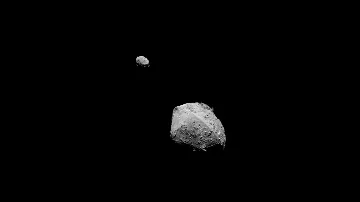
The European Space Agency's Hera mission has found a stadium-sized crater on the asteroid Dimorphos, left when NASA's DART spacecraft deliberately struck it in 2022. ESA published the first Hera images of Dimorphos, which orbits the larger asteroid Didymos, on 25 November 2026.
According to ESA, the crater has flattened one face of Dimorphos and the asteroid is now tumbling chaotically. Hundreds of previously unknown boulders also encircle the asteroid pair.
What the images show
One image from Hera's Asteroid Framing Camera was taken on 7 November 2026 from a distance of 29 km, with a spatial resolution of 2.7 m per pixel. ESA said the crater seems as wide as the impacted face of the asteroid and contains unusual structures, including an apparent cigar-shaped structure at its centre.
Hera principal investigator Patrick Michel, Director of Research at CNRS / Observatoire de la Côte d'Azur, said the face struck by DART "has been flattened into an impact crater the size of a sports stadium".
ESA said the rest of Dimorphos does not show evidence of major changes, with its boulder fields looking just as they did in DART's 2022 images. Michael Kueppers, ESA's Hera mission scientist, said the impact has left Dimorphos "tumbling wildly in its orbit".
The asteroid pair
Dimorphos is 151 m in diameter and orbits Didymos, which is 730 m in diameter, at an average distance of about 1 km. The pair is currently 193.5 million km from Earth.
On 26 September 2022, DART impacted Dimorphos and shortened its orbit by 33 minutes, much more than predicted. Telescopes on Earth measured the orbit change, but ESA said a fundamental question remained unanswered: what had actually happened to Dimorphos.
Next steps
The small-car-sized Hera spacecraft is observing with three instruments: the Asteroid Framing Camera, the multispectral Hyperscout H and JAXA's Thermal Infrared Imager, TIRI. It is currently flying about 25 to 30 km from the asteroids.
In December, Hera is scheduled to approach to around 13 km from the pair. In January 2027, it plans to deploy two shoebox-sized CubeSats, Juventas and Milani, which will venture closer still. ESA describes Hera as its first planetary defence mission.